
Why do I sleep so badly before my period?
Same bed, same bedroom, same book, same routine - and still, a few days before your period starts, sleep seems to fall apart. Then your period arrives, and within a few days everything is back to normal. Hardly anyone talks about it, but if this sounds familiar, you're in good company. So why does that happen?

What happens in the luteal phase?
At the beginning of the luteal phase - the phase between ovulation and menstruation - progesterone rises sharply to prepare for a possible pregnancy. Progesterone is a calm-inducing hormone that also helps our sleep. When there is no pregnancy, it falls sharply — and some of us notice that in our sleep.
The other thing that happens is that our body temperature rises. It's only about half a degree Celsius, which seems negligible. But it affects our sleep as well: we depend on a drop in our temperature to fall asleep, so when we start warmer, that drop is smaller and our sleep tends to be lighter.
This is not a malfunction of the body — it's completely normal during our cycle. But of course, knowing it's normal doesn't make lying awake in the middle of the night any more fun.
Why does it get worse in your 40s?
So why does it get worse in our 40s, in perimenopause? Our hormones fluctuate more — especially progesterone and estrogen — leading to longer or shorter cycles, stronger or lighter periods. The whole cycle becomes less predictable.This and the fluctuation of the hormones makes it harder to see the bad-sleep days coming.
Can you do anything about it?

Honestly? You can't overrule your hormones — and you shouldn't try. I'd be careful with anyone telling you that you can. But you can work with your body in the luteal phase instead of against it.
Try to stick to your bedtime ritual more consistently during that week before your period, without putting yourself under additional stress, of course.
Be a bit more attentive to your alcohol and caffeine consumption. Especially the caffeine part is extremely difficult for me - I LOVE coffee… Maybe skip that glass of wine, or reduce the coffee you would normally have in the afternoon.
Adjust your expectations. Even just knowing that you're in that certain week - and that with falling progesterone your sleep won't be as deep - can bring a lot of peace of mind.
How do you find your own pattern?
Of course we are all different - we're all unique. The best way is to watch your own body. Just jot down which day of your cycle it is and how you slept. Often it only takes 2–3 cycles to see a pattern. Maybe your sleep dips 4 days before your period starts, or the whole week before your period is lighter. Or you notice it's not the luteal phase at all, but something completely different - for example blood sugar dips in the middle of the night (if your sleep trouble includes regularly waking around 3am, that has its own set of causes — I wrote about them (here).
Either way, it helps a lot to get to know your own body and its patterns.
The easiest way I know to see it
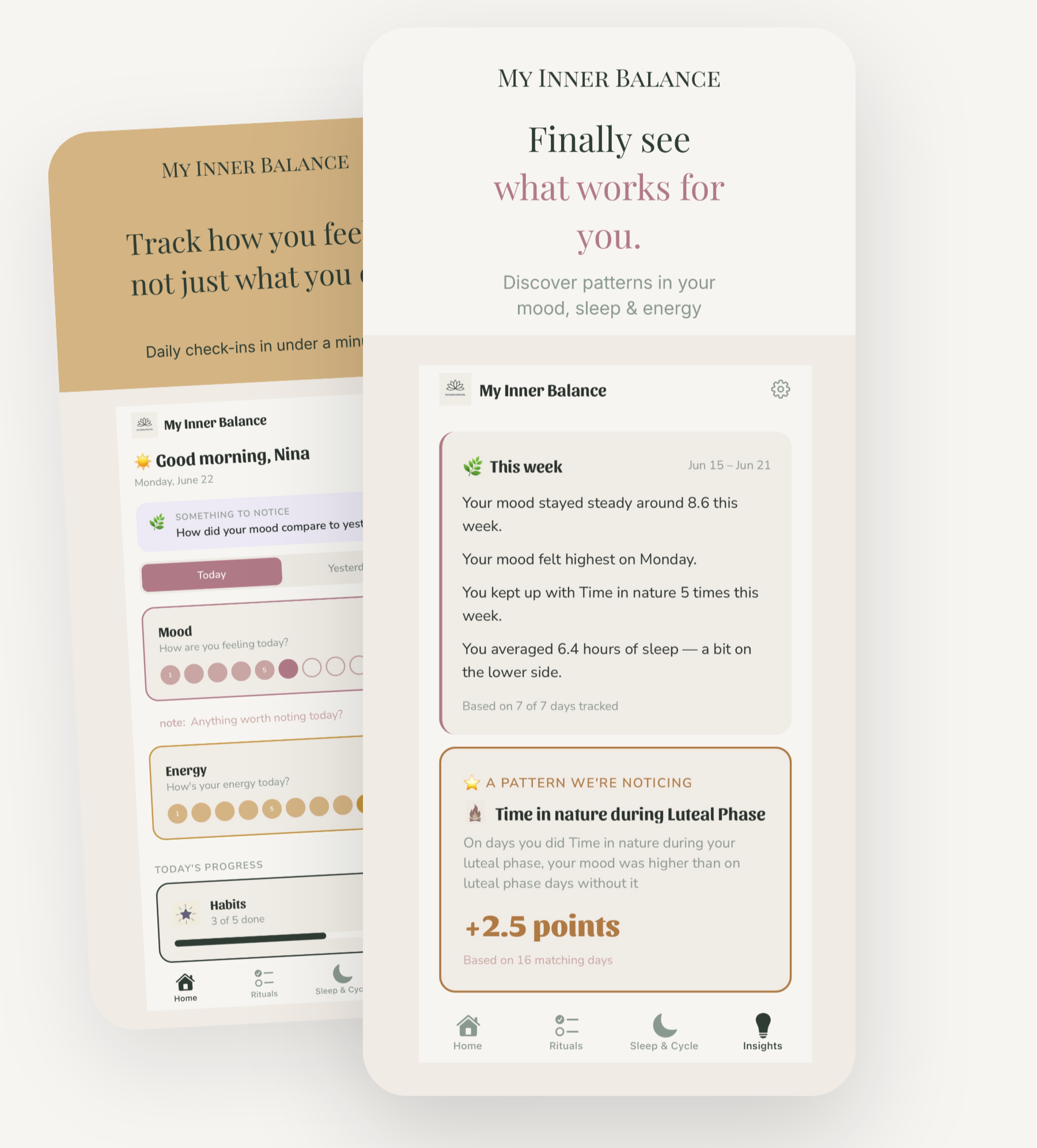
This is exactly what I built my app My Inner Balance for: getting to know your body and your patterns, so you don't have to rely on generic advice. You log your sleep, cycle, energy and mood - no pressure, no guilt, no dashboards to decode — and it quietly shows you the connections between your cycle, sleep, mood and energy. From your own data. Your own patterns.
Discover My Inner Balance
Not ready for an app? Start smaller: my free 7-Day Cortisol Experiment is a gentle, guided week of noticing what steadies your energy and sleep — a 10-page guide with a simple daily focus, delivered straight to your inbox.
A gentle note: if the days before your period regularly bring severe mood changes or sleep loss that seriously disrupts your life, please go see your doctor — conditions like PMDD are real, and they're treatable. This article shares patterns, not diagnoses.
