
Why do I keep waking up at 3am? What your body might be telling you
It's 3:12am.

And suddenly you're wide awake. Nothing woke you. No noise, no bad dream, no alarm. But now you're awake, and your mind is already going through the to-do list for tomorrow or thinking about that email from your boss. You try not to look at the time, try to turn around and get comfortable again. And some time around 4:30 or 5:00 you finally fall back to sleep — just in time for your alarm to go off, leaving you feeling like you didn't sleep at all.
I had that problem for a while, too — trying to be especially quiet so as not to wake my husband, which made falling back to sleep even harder. Often reading on my kindle for a while.
If you know what I am talking about, this is for you.
First, let me tell you: you're not alone
Sleep disruption is one of the most common complaints among women in perimenopause — studies suggest up to 60% of us are affected, and waking between 2 and 4am is among the most frequent patterns. So it's not because you looked at your phone once after dinner or turned on the bathroom light before bed. Your body runs on rhythms, and something in those rhythms may have shifted. The question is what.
There are three explanations that come up again and again — chances are, one of them is yours.
Is it cortisol?
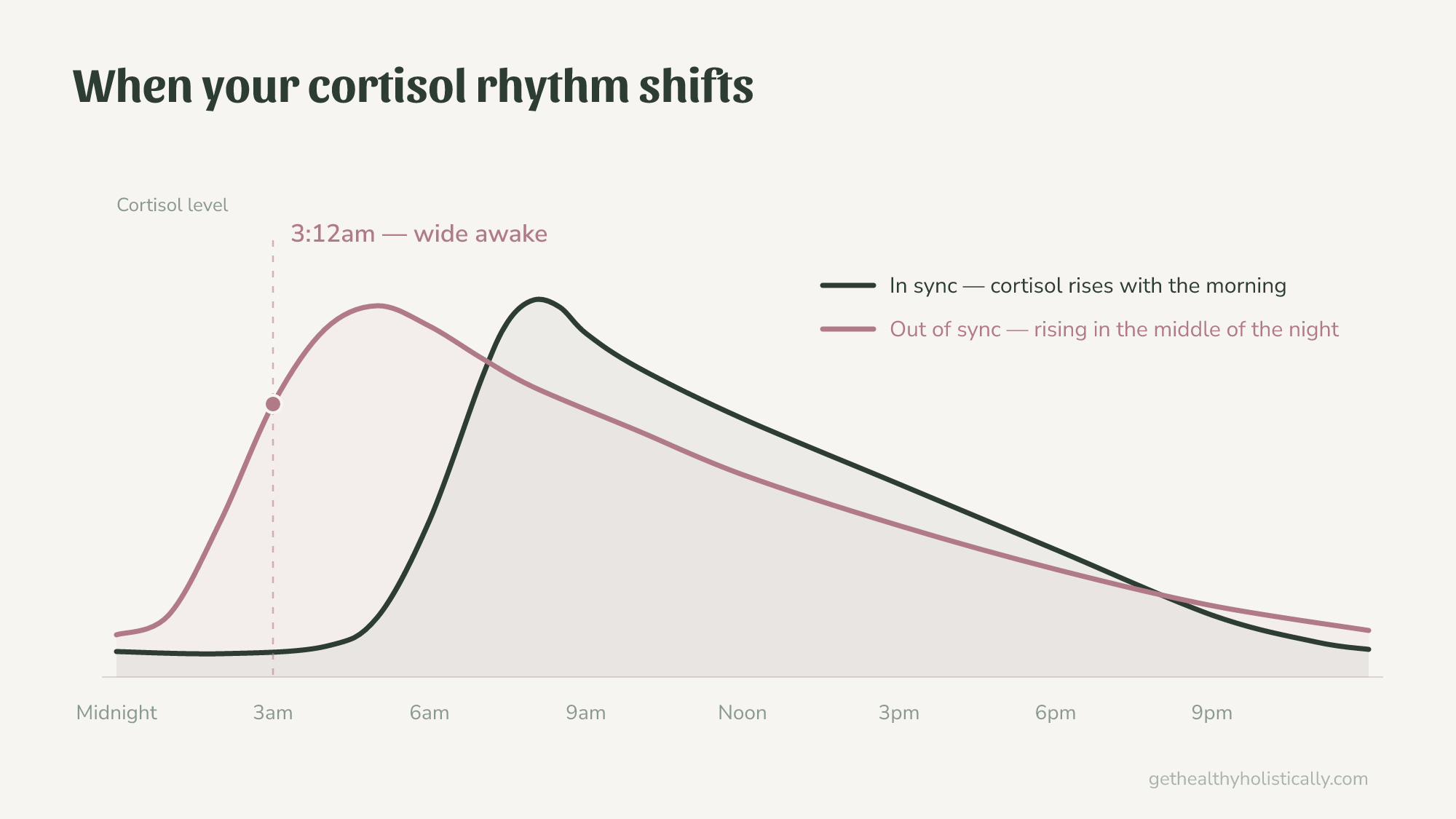
a simplified version of a typical and out-of-sync daily cortisol curve
Cortisol gets a bad reputation, even though without it we wouldn't wake up at all. It's the hormone that gets us going in the morning. When everything is in sync, cortisol rises in the morning — the cortisol awakening response — then declines during the day to let melatonin take over and let you sleep. The problem arises when the whole rhythm is out of sync and cortisol rises too early, waking you up in the middle of the night.
The telltale sign: you don't just wake up — you wake up wide awake and alert. If that's you, have a look at my free 7-day cortisol experiment guide, which helps you observe what is going on during your day.
Is it your hormones?
If you're in your 40s, there is another candidate: progesterone. It's one of the two main hormones of your cycle, alongside estrogen. Progesterone has a calming, sleep-supporting effect. Unfortunately, it is usually the first hormone to decline in perimenopause — often before you see any changes in your cycle.
Now add estrogen to the picture — the second hormone to decline, and the one behind hot flashes, night sweats and so much more — and you have a combination that can turn your sleep into something much lighter and more fragile. Sometimes you wake up fully; other times your sleep just gets shallower without you knowing why.
The telltale sign: the 3am wake-ups cluster in certain weeks of your cycle; in other weeks you don't wake fully, but your sleep feels shallower.
Is it blood sugar?
This one you don't hear about that often. If your dinner was light, early, or mostly carbs — or if there was some alcohol involved — your blood sugar can dip during the night. And a dip in blood sugar gets treated as an emergency by your body: it releases stress hormones — including cortisol, the same hormone from above. Those stress hormones wake you up.
The telltale sign: it happens more on days when you ate early or lightly, or after evenings with alcohol — and sometimes you wake up with a slightly racing heart, or even a little hungry.
So which one is it for you?
Honestly, from a distance nobody can tell you. Not this article, not a podcast, and not the supplement aisle. Any of the three could be the culprit behind your problem — or a combination.
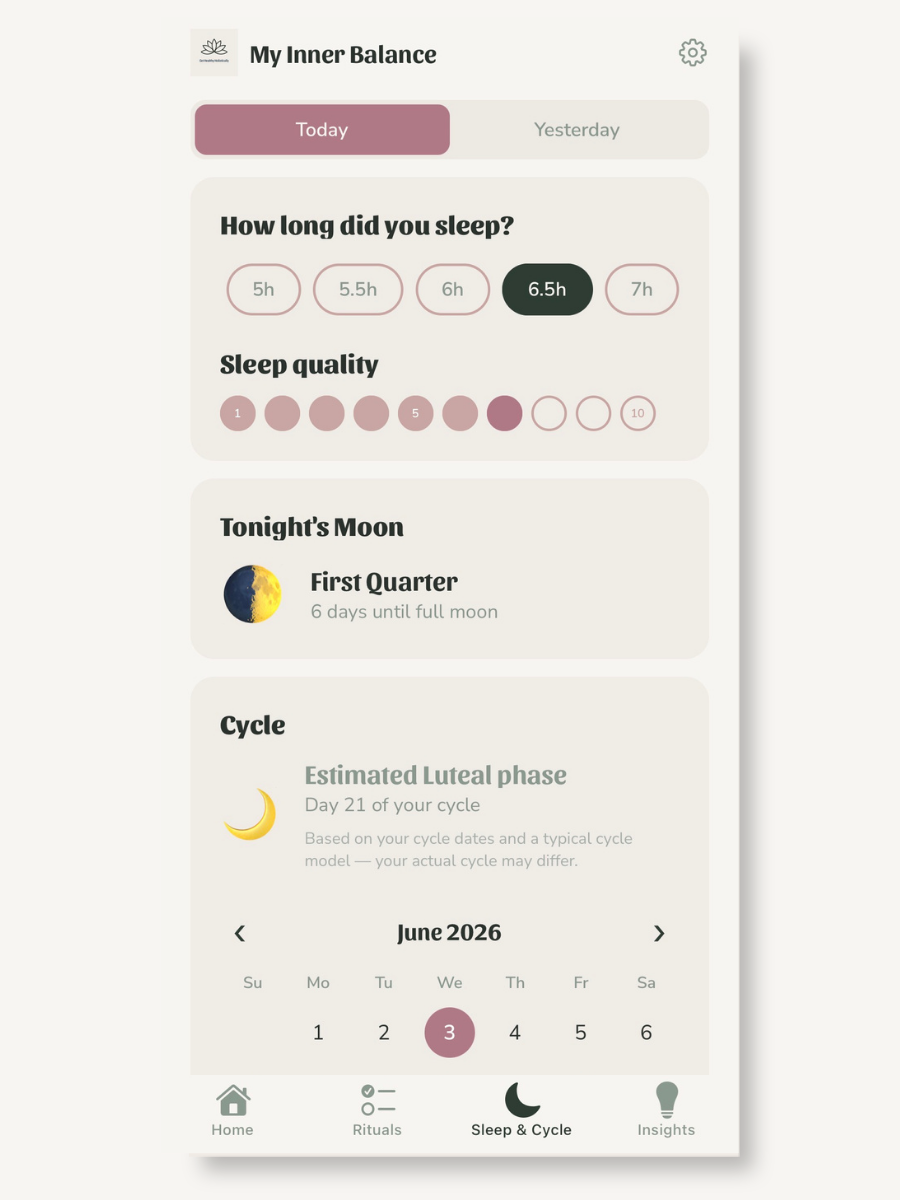
But your body can tell you, if you give it some attention and some time. Not with expensive lab tests or complicated protocols — just a few days of gentle noticing: When exactly do you wake up? What did your evening look like, your dinner? How stressful was the day? Where are you in your cycle? (If you'd rather not keep notes on paper, this is exactly what I built my app My Inner Balance for.) After a week or two, most women see something they have never noticed before — because the night doesn't exist in isolation. Your sleep is connected to the day before.
That shift from blindly guessing to noticing what is going on in your body changes everything. It's the difference between trying random fixes and actually understanding your own sleep.
A gentle place to start
That's exactly why I created the free 7-day cortisol experiment: a short guided week with a simple daily focus to steady your system in the morning, during the day, and in the evening. No rules, no pressure. Just a 10-page guide and a tracker, delivered to your inbox right away.
A gentle note: this article shares patterns and possibilities, not medical advice. If your night waking comes with a pounding heart or panic, or if it has been wearing you down for a long time, please talk to your doctor — that's not a defeat, it's information.
