
Nothing has changed but you still gained weight
You eat the same. You move the same. You do the same exercise. And still, when you step on the scale, you have gained a few pounds. Or, nothing has changed on the scale, but your pants don't fit the same, especially around the middle.
You know what I'm talking about? It happened to me, I gained 10 pounds. And I really thought about what I might have changed over the previous months. But I couldn’t think of anything. So, what happens in the body during perimenopause and menopause, why does that often mean seeing a few extra pounds on the scale, why does that extra weight tend to show up around the middle and what can you do about it - and what did I do. Also, which step to take first, because changing everything at once just doesn't work.
2. My 10 pounds
My weight had been pretty stable for the past few years. Of course I do weigh more than I did in my 20s. And it does fluctuate, 4 pounds more or less, that's normal I would say. But this time the scale showed 10 pounds more, going over the 130 pound mark. Not overnight, more like creeping up over the course of a few months. And I really thought about what I had done differently. I just couldn't think of anything. I mean, 10 pounds is not so bad. But they showed around the middle. And I didn't want the weight on the scale to go up even more. Because at my age they don't just go away on their own, the weight can keep creeping up. I can't be sure that the hormones are to blame. But it would make sense.
3. What happens in the body?
Hormones / Estrogen
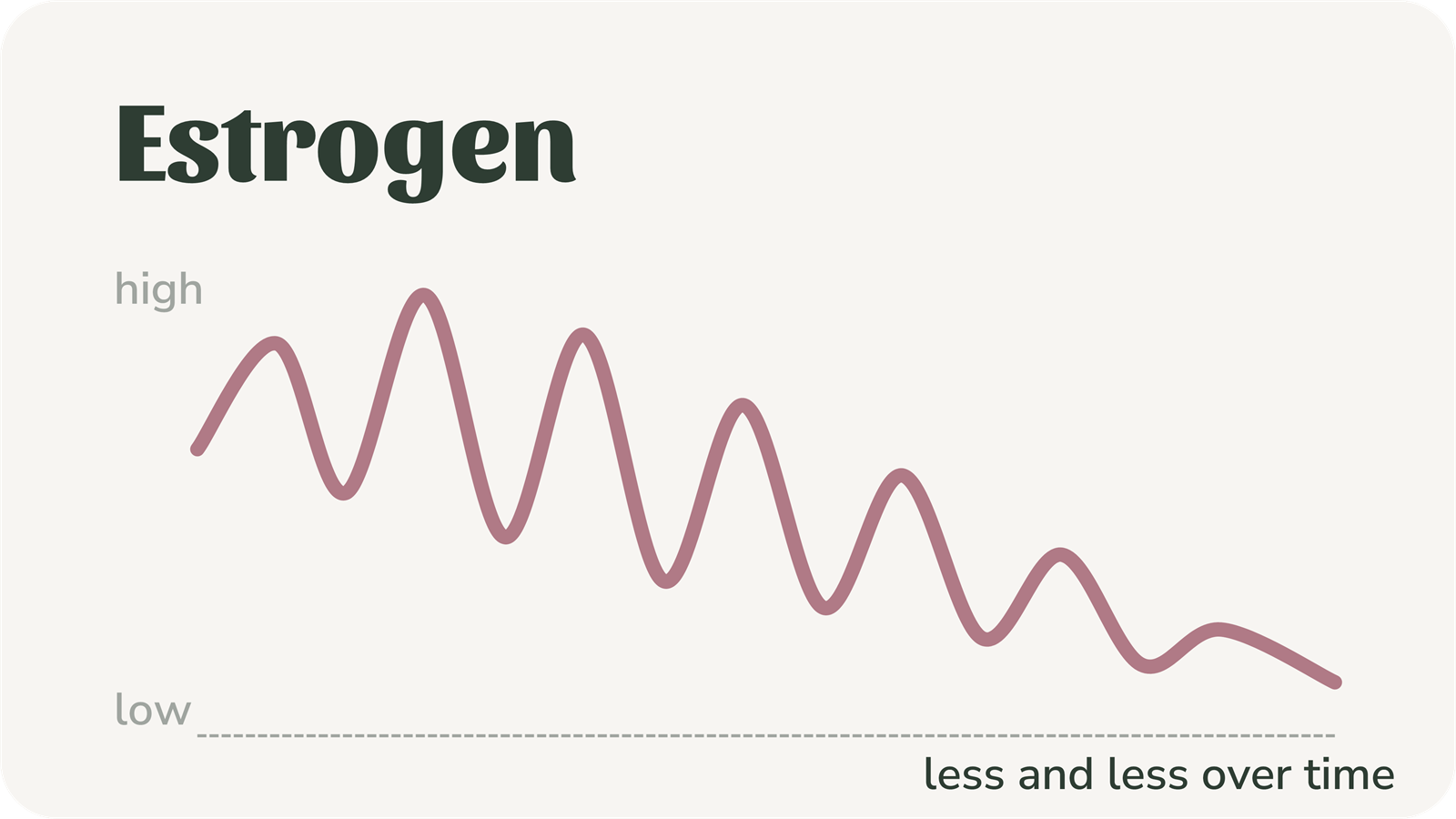
So what happens in the body with our hormones in perimenopause? Estrogen fluctuates, sometimes it's really low, other times it spikes up really high. Over time it decreases more and more. Estrogen is not only responsible for our cycle. It has a lot of different roles in the body. One of them is influencing where fat is stored and released. As long as there is enough estrogen, the female body tends to store it around our hips, butt and thighs, the typical female pear shape. When estrogen decreases it tends to shift storage to around the belly, including visceral fat, deeper in the abdomen around the organs. So the fat doesn't move from your butt to your belly – the body just starts storing new fat around the belly. You might not even see a change on the scale, but you still have trouble buttoning up your pants.
Muscles and energy expenditure
At the same time body composition changes. The body fat percentage increases while the fat-free mass decreases, unfortunately. That can include losing some muscle. This isn't only because of hormones, but also because of aging in general and because we often move less. But muscles are really important, because they burn energy, in other words calories, even when we aren't moving. They also absorb a lot of the sugar in our blood. So when our muscles decrease, our energy expenditure decreases as well and our body may have a harder time regulating blood sugar. Now energy expenditure doesn't plummet from one day to the next, but it decreases by just a bit. This alone does not explain my 10 pounds, but it's a piece of the puzzle.
General movement and sleep
And then there is something that we often underestimate. The exercise we do is just part of the energy we spend each day. A much bigger part is what the body needs to function and our general movement during the day. Going shopping, taking the stairs, cleaning the house, getting the mail from the mailbox. Over the course of the day that is often much more than the half hour or hour of exercise. Another important piece of the puzzle is sleep. During perimenopause a lot of women don't sleep well. There are tons of reasons for that, but the hormonal changes can be one of them. And when we don't sleep well, we are tired. We may still push ourselves to do our workout. But the rest of the day we move less, because we really lack the energy. And we often don't even notice it. What is more, sleep affects our appetit. Can you relate? After a bad nights sleep you are more hungry. And not for an apple, but for something calorie dense like sweets oder chips. Bad sleep also makes our body less sensitive to insulin. The body has to produce more insulin for the same effect. This does not mean that every woman in perimenopause is insulinresistent. It just shows that our sleep affects our metabolism.
All the little things add up
And now let's look at the whole picture. We don't sleep well. Because of that we crave calorie dense foods like sweets or chips and eat a bit more. We move a bit less, because we lack energy. We've lost a bit of muscle, reducing our energy expenditure. And the fat that we gain, we gain around the middle. Each of these things is small on its own. But all of them add up over weeks and months - and at some point it shows on the scale - or the pants. We didn't consciously change anything. So it feels like it came out of nowhere.
4. What works in general? And what did I do?
So, what can we actually do about it?

Weight training
First of all, weight training, in some form or another.
And I mean just that: choose a form that you enjoy, otherwise you won't stick to it. Going to the gym is an option, or you train at home. I went to the gym for a while, now I train at home with a series on youtube. Weight training helps to retain muscle and through retaining muscle it helps keep up the energy expenditure. But not everything is about how we look, there is more to it. We need muscle as we get older. To be able to move, to lift stuff and to get up from the chair or the floor by ourselves. And it is a really cool feeling when you train and after a while you realize you can lift things you weren't able to lift before and don't need help. Something to keep in mind: Make sure your routine still challenges you. If you use the same weight, do the same reps time and time again, you may stop making progess. The body gets used to the strain and does not build anymore muscle. For the body to build muscle, gradually increase the challenge - that's called progressive overload. But - and that's my own experience - not too much too fast. That's what happened to me. And then my shoulder hurt. Be consistent, challenge the body, but don't push harder every single time. Not only the muscles have to get used to the training, the joints and tendons as well. If something hurts, you can't or won't train. And then you're back to square one. A quick word about ab workouts. Training the abs is important, they stabilize the whole body. But even if you did ab workouts all day long, the body still decides where to get rid of the fat. So you can't get rid of that bellyfat by only working out the abs. And the last reason for today why weight training is so important: When you lose weight you lose fat and muscle. We want to keep muscle loss as small as possible, because muscles use up energy.
Cardio

The second thing that helps is cardio.
Running, brisk walking, cycling, swimming. It helps to reduce body fat, especially the visceral fat in the abdominal reagion. I'm not talking about running around panting like crazy. Moderate movement, you should still be able to have a conversation and should be able to keep going for a while. You often see on social media that women in perimenopause shouldn't do moderate cardio, like zone 2. Supposedly it stresses the body too much, cortisol rises and that's bad - leading to not losing weight or even gaining weight. But a temporary rise in cortisol during exercise is not the same as harmful, ongoing stress. It's a normal reaction to the training. The same thing happens when you do intensive weight training, which, according to social media, is exactly what we should be doing at our age. Your training needs to match your fitness level - and you need to eat enough and recover enough. I want to run my first marathon in fall next year. That's what I am training for right now. But last week I was really tired, did't have any energy. And I had also not slept well. So I didn't do any runs or workouts for a few days. I was pretty torn between working out anyway to stay consistent, and resting. But recovery is a big part as well, that's when the body adapts. And just like with weight training, it's not all about losing weight to look better. I also want to be able to do fun things in the future, like cycling, hiking, running - without panting immediately. Or having to skip it altogether because I'm not fit enough.
Nutrition
Then there is nutrition.
And I'm not talking about starving yourself. If you want to lose weight, you need to be in a slight energy deficit. What does that mean exactly? You have to eat a bit less than your body burns. And how do you do that without being hungry all the time? I tracked my calories with an app for 2 months. I wrote a blog post about that, I'll link it here. And I actually learned a lot while tracking. Now I make sure that I eat enough protein, meaning that there is a protein source in most of my meals. Protein keeps you satiated. Also enough fiber: veggies, fruits, whole grains and legumes - they fill you up and keep you full for longer. And what I noticed for me personally - I always need carbohydrates. It doesn't matter how much protein is on my plate, without carbohydrates I don't really feel full after a meal. The tracking also showed me where the calories were adding up. Nut butter, nuts, granola, cacao nibs and of course oils and fats. My breakfast sometimes had about 800 calories, because all of those little bits adding up. And that was a bit much for my overall energy expenditure. Which doesn't mean that I don't eat nuts or nut butter anymore. Not at all, I still eat them, I am just more aware of it now. Of course this doesn't explain why I gained those 10 pounds. I ate the same breakfast before and didn't gain weight. But it showed me where I can adjust what I eat a bit without having to change everything about my nutrition. This is my experience. So I think it's really important that you take a look at your eating habits. Which meals keep you satiated and full for longer? What works for your body? And what can you do consistently over time? Especially now that I am running more, I have to be aware of eating enough. If I increase my training without eating enough to support it, that can affect my recovery.
Sleep
Fourth, sleep.
We've already covered how poor sleep affects our appetite and how much we move throughout the day. So again: Sleep isn't something to squeeze in once you've taken care of everything else. It's a necessity.
And there are a lot of tips on social media: fixed bedtime, cool bedroom, no phones in the bedroom, blackout blinds, meditate and so on. I have tried a lot. And I have also dropped a lot of it again as well. For me a fixed bedtime is important, since I always wake up at the same time in the morning, no matter when I go to bed. And for winding down I always need to read a few pages of a novel. But everyone is different. You have got to find out for yourself what works for you. For example, I also tried meditation at night before bed. And at some point I realized that it stressed me more than it helped me. So I dropped it.
5. What would be a great first step
And now you might be thinking, great, how am I supposed to do all that? Weight training, cardio, change my nutrition and work on better sleep?
You don't have to and it actually usually doesn't work trying to change too much in your life at the same time . It might work for a few days, but then something comes up. And that's the end of it, back to normal, back to before. A better option is to ask yourself, what is most important to me right now? What could I realistically fit into my daily life? It should be something that you don't dread just thinking about it. Something small, like getting off the bus one stop earlier and walking the rest. Or taking the stairs instead of the elevator. Walking around the block on the weekend. Or, if nutrition seems easier to you, start by making sure to integrate some protein into most of your meals. Or focus on a bit more fruits or veggies during the day. It's not about changing up your whole routine and getting everything perfect. It's about the little steps that you can take every day, consistently, over time.
So, what could that first step be for you? Anything you can think of to try for the next two weeks?
